World War Soldier Information
"Lest We Forget Them"
This page shares the wartime stories of my own family members who served during the Great War, alongside individuals I have researched for clients and for the repatriation of military medals and awards. Each biography is accompanied by a photographic archive featuring military records, portraits, unit photographs, maps, medals, and other related wartime material that helps preserve and illustrate their stories.
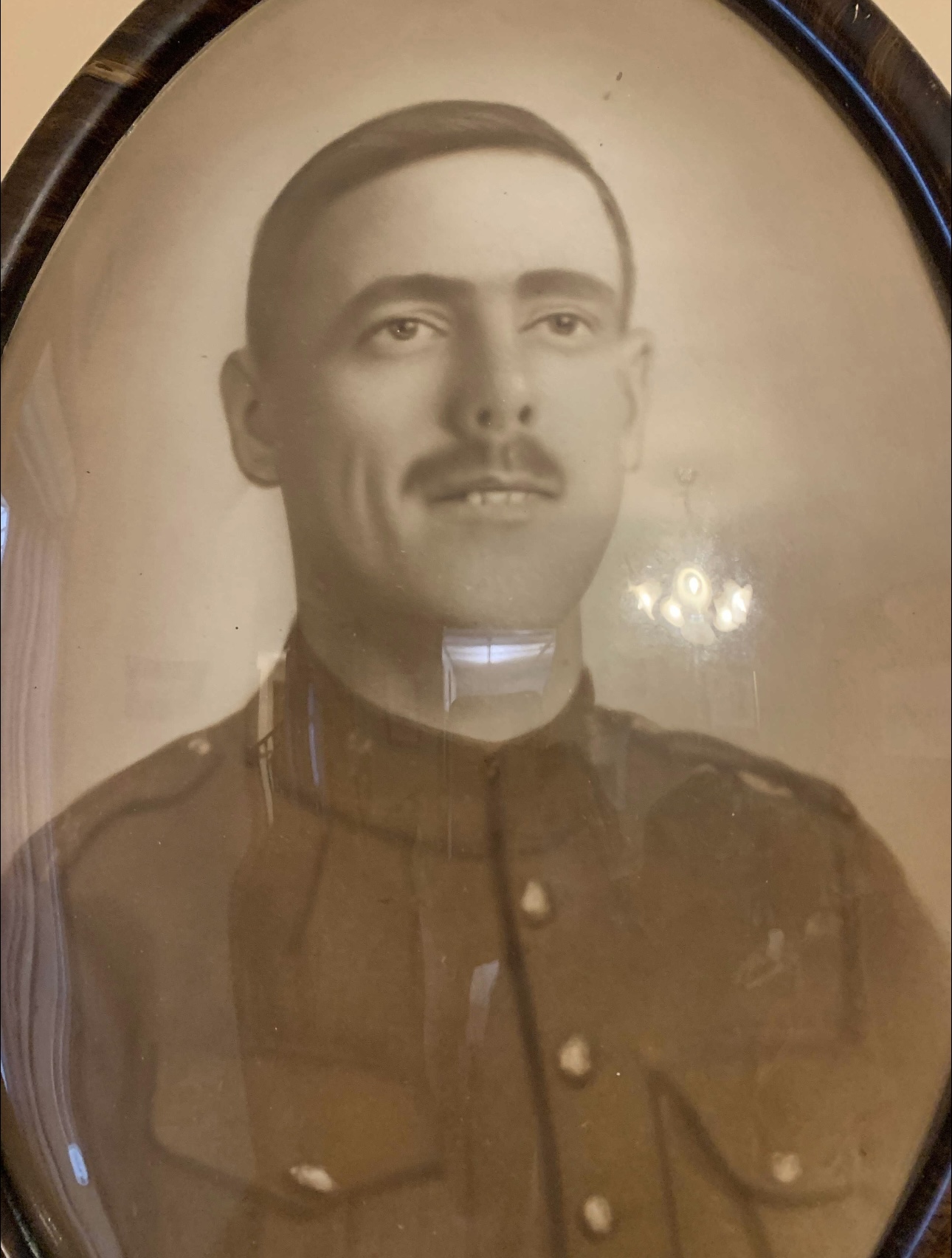
Robert, Tomkinson., C.E.F. Rgmt#826245
Canadian Expeditionary Force, 143rd B.C. Bantams & Canadian Railway Troops
Robert Tomkinson served with the Canadian Expeditionary Force during the First World War. He signed up in March of 1916 in Kamloops, B.C. He first served joining the 143rd Unit, the B.C. "Bantams." These battalions were created for shorter men who did not meet the regular height requirments of earleir recruitment standards. With traiing taking place in Sydney, B.C., he was for a time close to home. In France, March 1917, he was transfered into the 3rd Bttl. Canadian Railway Troops, where he became part of the essential military labour force responsible for maintaining railways, supply lines, and movement behind the Western Front. The work was physically exhausting and frequently conducted under heavy shellfire. Robert was one of the many Canadian soldiers whose war service reflected the difficult and often overlooked labour behind the front lines of the first World War. Robert's journey carried him from British Columbia to England and eventually into the dangerous railway sectors of France and Flanders.
Robert embarked from Canada to England and in February 1917 and was later transferred to the 3rd Battalion, Canadian Railway Troops. In March 1917 he proceeded to France, arriving at Boulogne. His service record shows hospital treatment in April 1917 for a contusion to his right foot, after which he rejoined his unit in the field.
By May 1917, Robert was serving in France and Flanders with the Canadian Railway Troops. These men built and repaired railway tracks, dugouts, and supply routes, often under dangerous conditions and enemy shellfire. His service continued through much of the war, and he was later transferred to the 69th Battalion, Wing Engineer Corps before being discharged after the Armistice. He was awarded the British War Medal and the Victory Medal. His orginal medals are not in my possession. Below is a stock photograph of them.
His surviving casulaty forms and service records provide a remarkably detailed timeline of a Canadian soldier whose contributions helped maintin the logistcal backbone of the Allied armies during the Great War.
Photographs & Records Related to Robert Tomkinson



Harry James Barley #186242
Duke of Cambridge’s Own Middlesex Regiment & Machine Gun Corps
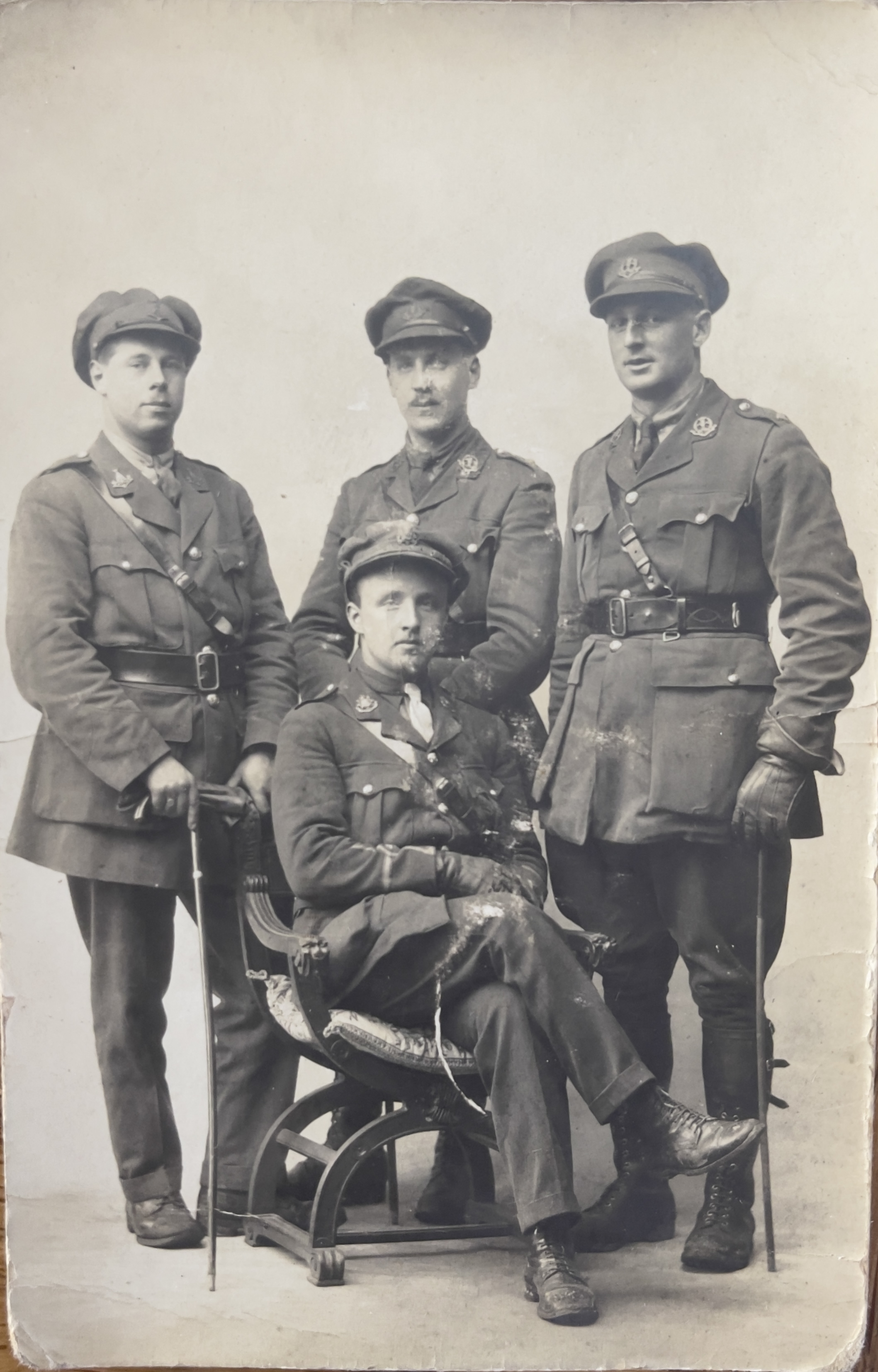
Harry James Barley, my maternal great grandfather, served as an officer during the First World War. He was connected to The Duke of Cambridge's Own Middlesex Regiment and later served with the Machine Gun Corps. He was sent to France in July of 1916 shortly after the opening of the Battle of the Somme.
Harry was listed as a temporary Second Lieutenant in the Middlesex Regiment in 1915. "London, Gazetter, November, 1915." His later service with the Machine Gun Corps suggests that he was part of the changing structure of the British Army as the machine-gun units were reorganized into specialized companies and battalions. Often. From my research I have found the war diary's and can trace his exact route through the war. Received British War Medal, Victory Medal, Military Cross. Roll Card: NW/5/5041 BW+VM, IV3315/W. 24.10.21 The London Gazette 1 October 1915, lists Harry James Barley as temporary Second Lieutenant to The Duke of Cambridge’s Own (Middlesex Regiment). [link] Still in research of his battalion. The probability of pathway is: Middlesex Regiment to 33rd Division Machine Gun Company, to 33rd Battalion M.G.C. This is based on his unit’s office for awarding the medals, his home address during the war, and knowing his first regiment. We know he was in the Duke of Cambridge’s Own (Middlesex) Regiment and served with the MGC. It’s plausible his machine-gun service was within the 98th Brigade M.G. Company, which later merged into the 33rd Battalion M.G.C. He is also listed as The Duke of Cambridge’s Own, (Middlesex Regmt), as 2nd Lieutenants. Barley, H.J. 23 Sept 1915. I have traced their journey into France, where the Middlesex Regiment gets split up to assist on the front lines. All units suffering casualties and direct conflicts. Stories of incredible faith and resilience against their enemy. There are some extremely heroic stories such as Cpt. H? These can be found in “History & Memoir of the 33rd Battalion M.G.C.” Written by the battalions themselves, it is an excellent account covering the 19th, 98th, 100th and 248th Companies and the 33rd Battalion. The National Archives also has the battalion diary. Searchable under WO 95/2417/2. The Middlesex Regmt. Supplied many officers & men to newly formed Machine Gun Corp. companies in 1916. Such as: 18th dvs. from the 7th and 18th Battns. Middlesex Rgmt., attacked @ Mountauban & Delville Wood. 33rd dvs. from the 16th Battns. Middlesex Rgmt, in Guillemont & High Wood. 41st dvs. from 12th Middlesex Rgmt., Flers-Courcelette, Sept 1916. It’s most probably that Harry is in the 33rd Battalion. Based on his medals and arrival in France.
My research suggests a possible pathway from the Middlesex Regiment into a Machine Gun Corps unit connected with the 33rd Division. Further research is still needed to confirm his exact battalion or company. Harry received the British War Medal, Victory Medal, and Military Cross. He returned from France and settled in Cornwall with his wife Annie. They had one son. Ronald Alfred Barley.
Photographs & Records Related to Harry James Barley


Walter Henry Barley
Royal Army Service Corps & Transport Service
Walter Henry Barley is Harry's Father and served during the First World War with the Royal Army Service Corps. Born in 1867, he was older than many men who served, and his occupation as a "saddler" would have made him especially useful in transport and supply work. He worked closely with the horses during WW1.
Walter enlisted in June 1915, almost as if to say to his Son Harry, "I'll go first." As with Harry's arrival date in France, and pretrainign time considered back home, we surmice his father did in fact enlist first to perhaps go before-hand. This I do not know for certain. He served under the regimental number T5/1958. The Royal Army Service Corps was responsible for moving food, ammunition, equipment, fuel, and other supplies needed by the British Army. This work was vital to keeping the front lines functioning.
His records suggest a transport-related service position, involving horse transport, mechanical transport, & territorial force units which were later absorbed into regular army terms. Walter was discharged for disability on 11 November 1918, (The date does not cease to amaze me). It is of course, the same day the Armistice ended the fighting in Europe. Walter does not have a lot og photographic evidence. He remains elusive among my hundreds of inherited family photographs. I have one. Shared here, of a grainy old photograph on a field, with what looks like a puppet of some kind that Walter is posing.
Photographs & Records Related to Walter Henry Barley


Kelson
Unit and force
Prvt. KELSON and the Missing Medals.
In my passion for perservation, history, family orgins and everything in between that, something was telling me to look for my great-grandfather's medals. They were awarded to both men. I have long been a custodian for things of family importance or treasure that should be saved for future generatinos. When I say the add come up at my local military outlet, I decided I had to go in right-away, on my lunch break in fact, clear across my City, to get these medals that my great grandfather's had been awarded. I wanted to see them and feel them. I wasn't sure, but I felt the need. The shop keeper and I had a lovely long conversation about WW1 medals and how they are indeed hard to come by or find. I just couldn't believe some families would let these disapear! But he assured me it was either the passage of time, no descendants or pure none-interest from family.
So I went ahead and bought them and he showed me the name etched on the edges of both medals. Wonderfully enough, they weren't different and two medals had stayed together from the same soldier. The name was Kelson. Prvt. E. That's all it said. No full front name. I left the shop still pleased and sat in my car for a moment thinking about my great grandfathers. holding their medals. Finally. Maybe it helped me feel closer to family I've never met. but that feeling quickly changed into protectionism. For Prvt. Kelson. These were his of course, and I felt another pull to find Kelson. Find any family that may be out there, to return his medals back into his own families fold.
I can't imagine how happy I would be to find my great-granparents medals. With their actual names on them.
Photographs & Records Related to Prvt. Kelson

